To estimate an enthalpy change from bond enthalpies, imagine the reaction happening in two stages: first every bond in the reactants is broken, then every bond in the products is made.ΔrH = Σ(bonds broken) - Σ(bonds made) Both sums use the positive bond enthalpy values; the subtraction gives the sign.Method
1. Draw displayed formulae so that you can count every bond.
2. List and total the bond enthalpies of all the bonds broken (reactants).
3. List and total the bond enthalpies of all the bonds made (products).
4. Subtract: broken minus made.Worked exampleH2(g) + Cl2(g) → 2HCl(g) Bond enthalpies: H-H = 436, Cl-Cl = 243, H-Cl = 432 kJ mol-1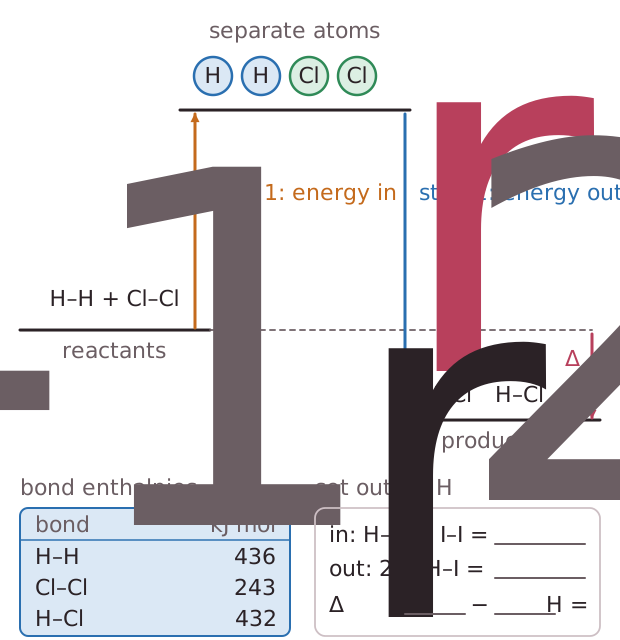 Broken: 1 H-H + 1 Cl-Cl = 436 + 243 = 679 kJ
Made: 2 H-Cl = 2 × 432 = 864 kJΔrH = 679 - 864 = -185 kJ mol-1 More energy is released making bonds than is needed to break them, so the reaction is exothermic.Why the answer is only an estimateMean bond enthalpies are averages over many compounds, so they are not exact for the particular molecules in the reaction. The method also assumes every substance is a gas. If a reactant or product is a liquid or solid, such as H2O(l), the energy for the change of state is left out, so the answer differs more from a value found using enthalpy changes of formation or combustion.A bond that is unchanged in the reaction can be left out of both sums, because it appears on both sides.
1. Draw displayed formulae so that you can count every bond.
2. List and total the bond enthalpies of all the bonds broken (reactants).
3. List and total the bond enthalpies of all the bonds made (products).
4. Subtract: broken minus made.Worked example
Broken: 1 H-H + 1 Cl-Cl = 436 + 243 = 679 kJMade: 2 H-Cl = 2 × 432 = 864 kJ