A titration is a method of measuring the volumes of two solutions that react together and using the results to determine the concentration of one of the solutions.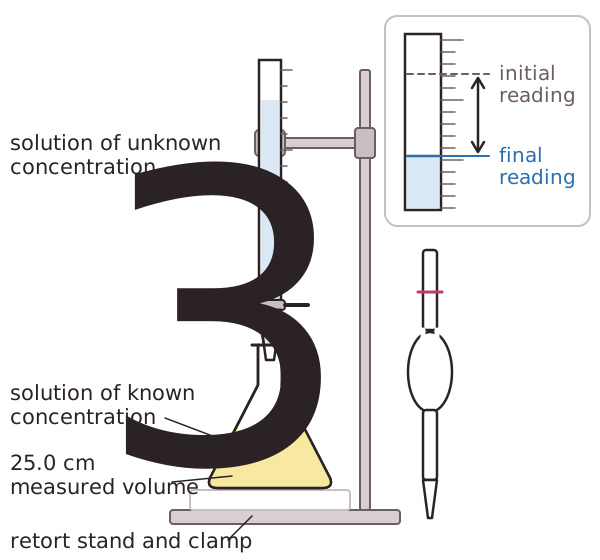 Titrations are also known as volumetric analysis.The titration is used to find an unknown concentration of a solution by reacting it with a solution of known concentration such as a standard solution.For example hydrochloric acid of unknown concentration was run in from a burette into 25.0 cm3 of 0.0800 mol dm-3 sodium hydroxide solution containing methyl orange, until the indicator turned from yellow to orange, showing the end point. 20.0 cm3 of acid was needed. Find the concentration of the acid in mol dm-3.NaOH + HCl → NaCl + H2O. The volume and concentration of the sodium hydroxide is known so the number of moles can be calculated.The equation says that 1 mole of NaOH reacts with 1 mole of HCl to make a neutral solution. Therefore number of moles of HCl can be calculated and if the volume is known the concentration can also be calculated.moles of NaOH = 0.0800 × 0.0250 = 2.00 × 10⁻³ mol = moles of HClconcentration of HCl = 2.00 × 10⁻³ ÷ 0.0200 = 0.100 mol dm-3