Skip to content

Bonding

A C=C double bond is made of two different kinds of covalent bond: one sigma (σ) bond and one pi (π) bond.The σ bond forms by direct (end-on) overlap of orbitals, so its electron density lies on the line between the two carbon nuclei. Each carbon of the C=C forms three σ bonds, and these lie in one plane at 120° to each other, so the arrangement around each carbon is trigonal planar.Each carbon also has one p orbital left over, at right angles to that plane. The π bond forms by sideways overlap of these two p orbitals. Its electron density sits in two regions, above and below the plane of the molecule.
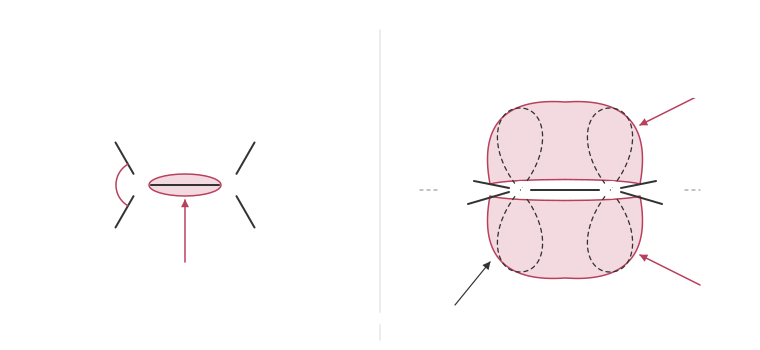
Because the π electrons are further from the nuclei and exposed, the π bond is weaker than the σ bond. The mean bond enthalpy of C=C is 612 kJ mol–1, less than twice that of C–C (348 kJ mol–1). The exposed π electrons make the C=C a region of high electron density, which is why alkenes are much more reactive than alkanes.The p orbitals can only overlap sideways while they stay parallel. Twisting one end of the molecule would break the π bond, so there is restricted rotation about a C=C bond. This is the origin of E/Z isomerism.

Read the text

Read the text and highlight anything you think is important. When you go on, the text is hidden and you answer from memory.