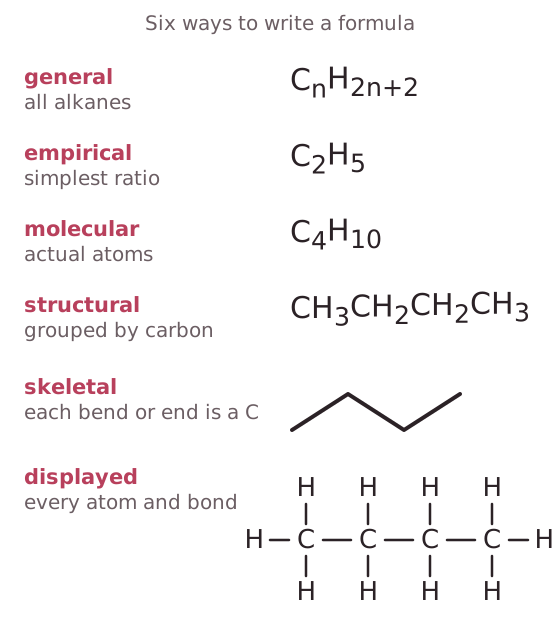
The empirical formula shows the simplest whole-number ratio of atoms of each element in a compound. The molecular formula shows the actual number of atoms of each element in one molecule.For example, ethane has the molecular formula C2H6 and the empirical formula CH3. Butene C4H8 has the empirical formula CH2.To find an empirical formula from masses or percentages, divide each by the relative atomic mass to get moles, then divide by the smallest number to get the ratio.To find the molecular formula, divide the relative molecular mass by the mass of the empirical formula unit, then multiply the empirical formula by that number.