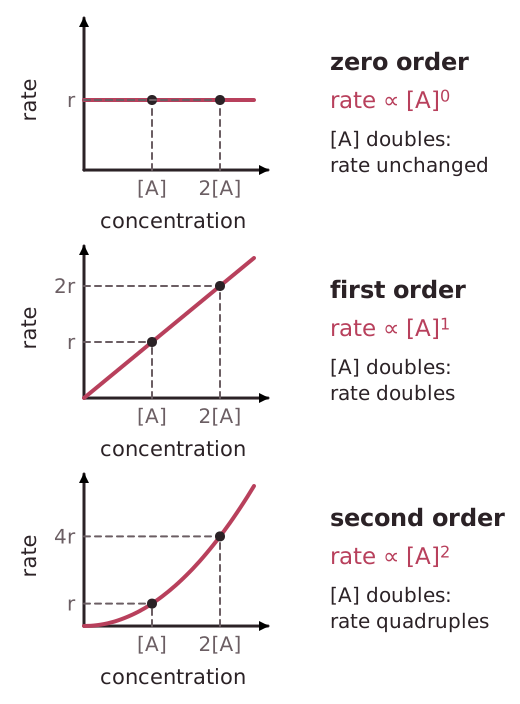
The order of a reaction with respect to a reactant is the power to which the concentration of the reactant is raised in the rate equation. If the order is zero with respect to a reactant then the rate is unaffected by a change in the concentration of that reactant.rate α [A] 0If the order is one with respect to a reactant then the rate is directly proportional to the concentration of that reactant and the rate doubles when the concentration doubles.rate α [A] 1If the order is two with respect to a reactant then the rate is directly proportional to the square of the concentration of that reactant and the rate quadruples when the concentration doubles.rate α [A] 2
The Order of a Reaction
Read the text
Read the text and highlight anything you think is important. When you go on, the text is hidden and you answer from memory.
Specification: Edexcel Chemistry (9CH0), A-level, Topic 16: Kinetics II. Topic: Rate of Reaction.
Key terms in this lesson
- bidentate ligand
- A ligand that can form two co-ordinate bonds to a central metal ion.
More in Rate of Reaction
- The Rate of a Reaction
- Measuring Reaction Rates
- Experimental Determination of the Rate of Reaction
- The Rate Equation
- The Rate Constant k
- Worked Example
- Half-Lives and Reaction Rate Graphs
- The Rate Determining Step
All 11 lessons in Rate of Reaction · All Edexcel A-level Chemistry topics