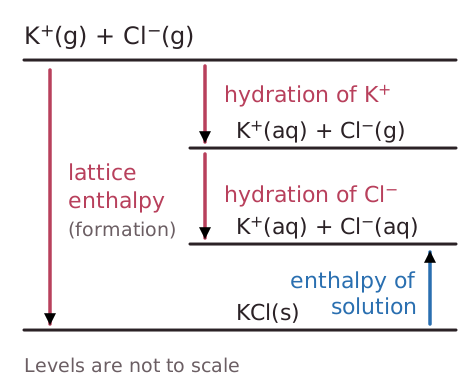
When a solid dissolves the ionic lattice breaks down or dissociates (endothermic) and the ions become hydrated (exothermic). The resulting enthalpy change is called the enthalpy of solution. The energy needed to break down the lattice is the lattice dissociation enthalpy. This has the same magnitude as the lattice enthalpy but has the opposite sign.The next stage involves the hydration of the gaseous ions. Energy is released when the ions form bonds with water molecules. This energy is the enthalpy change of hydration. A Born-Haber Cycle can be used to show or calculate the energy changes. The gaseous ions are placed at the top of the cycle and there are two routes that connect the gaseous ions to the ionic solid.