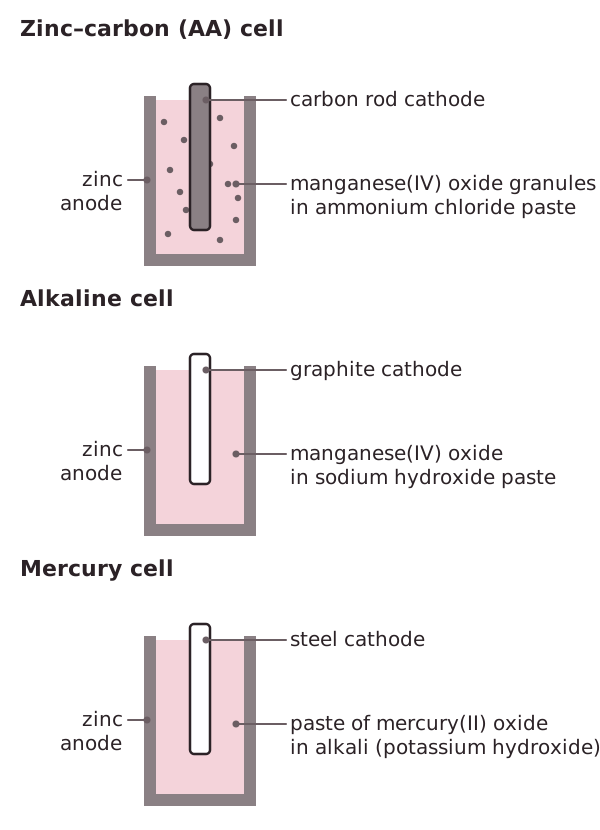
Electrochemical cells are used as a source of electrical energy. They are made of two half cells with different electrode potentials. There are three main types: Non-rechargeable cells, rechargeable cells and fuel cells. With non-rechargeable cells the reactions continue until the reactants are used up. The voltage then drops and the cell gets flat. It is then discarded.AA batteries consist of a zinc anode and cathode made of a carbon rod full of granules of manganese (IV) oxide in a paste of ammonium chloride (electrolyte). Alkaline batteries have sodium hydroxide as the electrolyte. At the anode zinc is oxidised.:Zn(s) + 2OH-(aq) → Zn(OH)2(s) + 2e-At the cathode manganese (IV) oxide is reduced to a manganese (III) compound.:2MnO2(s) + 2H2O(l) + 2e- → 2 MnO(OH)(s) + 2OH-(aq)Mercury batteries are used in watches and pacemakers. They have a zinc anode and a steel cathode and the electrolyte is a paste of mercury(II) oxide in alkali. The reactions in rechargeable cells can be reversed using electrical energy so the cell can be re-used. Examples are Ni-Cd (nickel-cadmium) batteries, lithium-ion batteries and lithium polymer batteries used in laptops.