 BRAINCAKE
Enthalpy Change of Solution
When a solid dissolves the ionic lattice breaks down or dissociates (endothermic) and the ions become hydrated (exothermic). The resulting enthalpy change is called the enthalpy of solution. The energy needed to break down the lattice is the lattice dissociation enthalpy. This has the same magnitude as the lattice enthalpy but has the opposite sign.
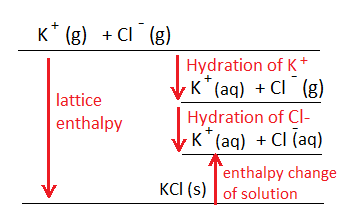
Sign in free to see the rest of this lesson, the R.E.C.I.P.E. recall steps and the quiz
BrainCake is free. Make an account in seconds and pick up where this page stops.
Key terms in this lesson
- lattice enthalpy
- The enthalpy change when one mole of an ionic compound forms from its constituent gaseous ions under standard conditions.
- enthalpy change of hydration
- The enthalpy change when one mole of gaseous ions dissolves in water to form one mole of aqueous ions under standard conditions.
More in Lattice Enthalpy
- The Standard Enthalpy Change of Atomisation
- First Ionisation Energy
- First Electron Affinity
- Lattice Enthalpy
- Born-Haber Cycles
- Born-Haber Cycle for Sodium Oxide
- Born-Haber Cycle for Calcium Chloride
- Enthalpy Change of Hydration
All 10 lessons in Lattice Enthalpy · All AQA A-level Chemistry topics