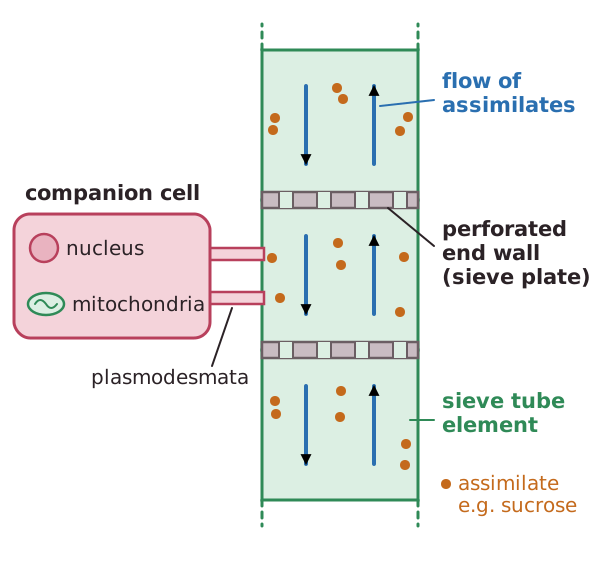
Translocation is the movement of organic substances and some minerals from one part of the plant to another.Substances being transported include sucrose and amino-acids.The parts of the plant where these substances are produced are called sources and the parts of the plant where they are used or stored are called sinks. Assimilates are moved from source (where they are made or taken into the plant) to sink (where they are needed, for example a developing flower).Assimilates can be used to make substances that the plant requires immediately, or they can be stored.Substances are transported in either direction by the sieve tubes of phloem tissue and include potassium, chloride, phosphate and magnesium ions.The rate of transport of these substances is too fast for diffusion alone. The current theory of how substances are transported in the phloem is called the mass flow hypothesis.