The grayling (Hipparchia semele) is a butterfly of heathland, sand dunes and coastal cliffs in Britain. It shows how anatomical and behavioural adaptations work together.Camouflage
The underside of the grayling's wings is mottled grey-brown. When it lands on bare ground, rock or tree bark it rests with its wings closed, so this colouring camouflages it and it is very hard for birds to see.The eyespot
The forewing has a dark eyespot. At rest, the grayling usually lowers its forewing so the eyespot is hidden behind the hindwing, keeping it camouflaged. If it is disturbed, it can raise the forewing to flash the eyespot, which may startle a predator or draw an attack away from its body.Controlling body temperature
Like other insects, the grayling is an ectotherm: it needs to be warm to fly, but must avoid overheating on hot sand. It controls its temperature by changing its position relative to the sun. When cool, it turns so that its closed wings are at right angles to the sun's rays and leans over, so a larger area of wing absorbs heat. When hot, it faces the sun so its wings are edge-on to the rays and less heat is absorbed. This is behavioural thermoregulation.Courtship
In classic experiments, Niko Tinbergen presented male graylings with model butterflies. Males chased darker models more often than light ones, and responded to models that moved in a dancing flight, showing that their courtship behaviour is triggered by simple visual signals.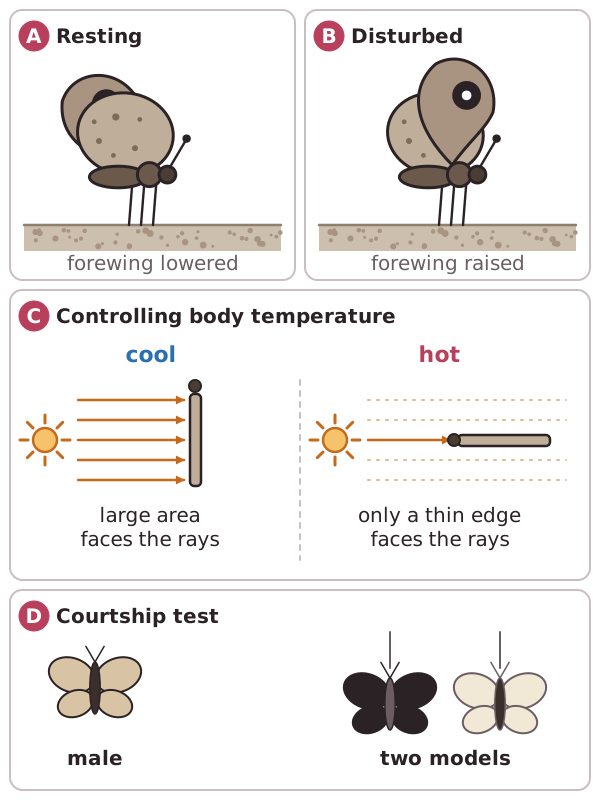
The underside of the grayling's wings is mottled grey-brown. When it lands on bare ground, rock or tree bark it rests with its wings closed, so this colouring camouflages it and it is very hard for birds to see.The eyespot
The forewing has a dark eyespot. At rest, the grayling usually lowers its forewing so the eyespot is hidden behind the hindwing, keeping it camouflaged. If it is disturbed, it can raise the forewing to flash the eyespot, which may startle a predator or draw an attack away from its body.Controlling body temperature
Like other insects, the grayling is an ectotherm: it needs to be warm to fly, but must avoid overheating on hot sand. It controls its temperature by changing its position relative to the sun. When cool, it turns so that its closed wings are at right angles to the sun's rays and leans over, so a larger area of wing absorbs heat. When hot, it faces the sun so its wings are edge-on to the rays and less heat is absorbed. This is behavioural thermoregulation.Courtship
In classic experiments, Niko Tinbergen presented male graylings with model butterflies. Males chased darker models more often than light ones, and responded to models that moved in a dancing flight, showing that their courtship behaviour is triggered by simple visual signals.