Organisms are classified into a hierarchy of groups. Each group is called a taxon (plural taxa). There are eight main taxonomic ranks, from largest to smallest:domain → kingdom → phylum → class → order → family → genus → species A mnemonic helps: 'Dear King Philip Came Over For Good Soup'.Each taxon is contained within the one above it. Moving down the hierarchy from domain to species:
• the number of organisms in each group decreases
• the organisms in each group share more features
• they are more closely related, sharing a more recent common ancestor.Worked example: the classification of humans and wolves.
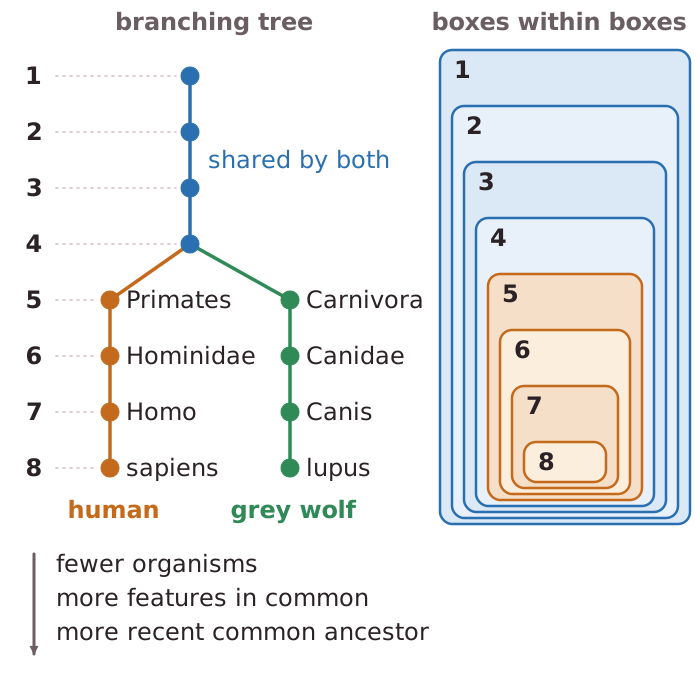 Two organisms that share a family are more closely related than two that share only an order.
• the number of organisms in each group decreases
• the organisms in each group share more features
• they are more closely related, sharing a more recent common ancestor.Worked example: the classification of humans and wolves.
| Rank | Human | Grey wolf |
|---|---|---|
| Domain | Eukarya | Eukarya |
| Kingdom | Animalia | Animalia |
| Phylum | Chordata | Chordata |
| Class | Mammalia | Mammalia |
| Order | Primates | Carnivora |
| Family | Hominidae | Canidae |
| Genus | Homo | Canis |
| Species | sapiens | lupus |
Two organisms that share a family are more closely related than two that share only an order.