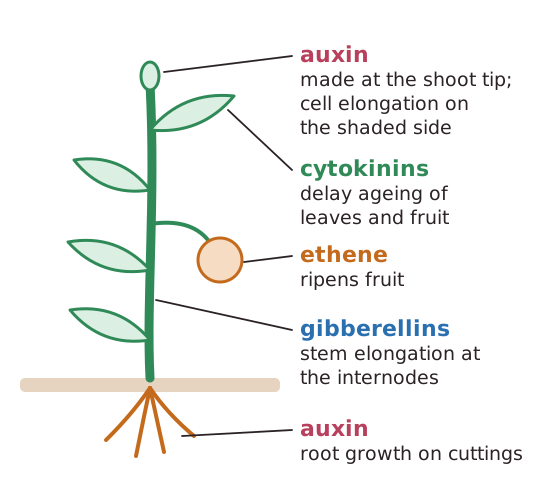
Plant hormones interact to allow the plant to grow. Weeds compete with crops for light, space, water and minerals. Most weeds tend to be broad-leaved dicots whilst most crop plants are narrow-leaved monocots. Applying synthetic auxins to fields with crops results in the uptake of the auxins by the broad-leaved plants. The growth rate increases to an unsustainable rate and the weeds die. Synthetic auxins used in this way are selective, cheap to produce and have low toxicity to mammals.
Hormonal Weedkillers
Read the text
Read the text and highlight anything you think is important. When you go on, the text is hidden and you answer from memory.
Specification: OCR Biology A (H420), A-level, 5.1.5 Plant and animal responses. Topic: Plant Responses.
Key terms in this lesson
- Hormone
- A chemical messenger, secreted directly into the blood by an endocrine gland, that travels to target cells and alters their activity.
- Auxin
- A plant hormone, produced mainly at shoot and root tips, that stimulates cell elongation and controls tropisms and apical dominance.
More in Plant Responses
- Pheromones
- Response to Touch
- Tropisms
- Growing in the Dark
- Geotropism
- Fruit Ripening
- Rooting Powder
- Other Uses of Plant Hormones
All 19 lessons in Plant Responses · All OCR A-level Biology topics