Artificial twinning is a way of producing several genetically identical animals from one embryo. It copies what happens naturally when identical twins form, but it is done deliberately by farmers and breeders, usually with high-value cattle.The steps are:
1. A cow with desirable traits is treated with hormones so that she releases more eggs than usual (superovulation).
2. The eggs are fertilised, either naturally, by artificial insemination, or by in vitro fertilisation (IVF).
3. The early embryo is removed (flushed out of the uterus if fertilisation happened inside the cow).
4. While its cells are still totipotent, the embryo is split into several smaller pieces.
5. Each piece is grown in the lab for a few days to form a new embryo.
6. Each embryo is implanted into a different surrogate mother, where it develops normally.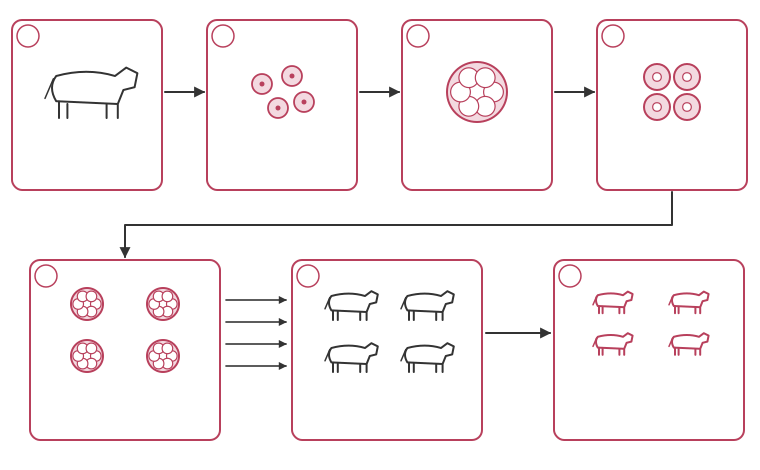
1. A cow with desirable traits is treated with hormones so that she releases more eggs than usual (superovulation).
2. The eggs are fertilised, either naturally, by artificial insemination, or by in vitro fertilisation (IVF).
3. The early embryo is removed (flushed out of the uterus if fertilisation happened inside the cow).
4. While its cells are still totipotent, the embryo is split into several smaller pieces.
5. Each piece is grown in the lab for a few days to form a new embryo.
6. Each embryo is implanted into a different surrogate mother, where it develops normally.