Skip to content

Homeostasis

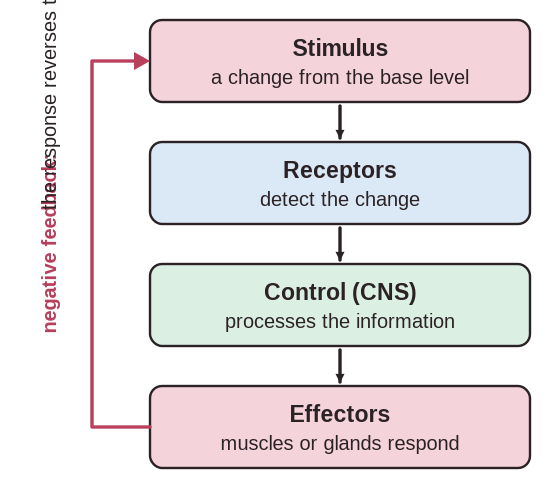
Homeostasis is the maintenance of a constant internal environment, maintaining a dynamic equilibrium with only small variations over a narrow range of conditions either side of the optimum.Homeostasis is maintained by sensory receptors which detect the changes in both the internal and external environments, the central nervous system which processes the information and effectors which bring about changes so that the equilibrium is restored.These control mechanisms in the body are based on negative feedback systems which restore conditions to a base level by reversing the direction of the change.
Read the text

Read the text and highlight anything you think is important. When you go on, the text is hidden and you answer from memory.

Specification: AQA Biology (7402), A-level, 3.6.4.1 Principles of homeostasis and negative feedback. Topic: Homeostasis.

Key terms in this lesson

intron
A non-coding section of a gene or pre-mRNA molecule that is removed by splicing before translation.
exon
A coding section of a gene or pre-mRNA molecule that remains after splicing and is translated into protein.

More in Homeostasis

All 33 lessons in Homeostasis · All AQA A-level Biology topics